General

The Real Math Behind a Personal Injury Contingency Fee

The Real Math Behind a Personal Injury Contingency Fee

What if the settlement you’ve been waiting months for finally arrives—and you walk away with far less than you expected, not because your lawyer did anything wrong, but because nobody explained the math upfront?

That question drives most of my evening consultations. Someone gets rear-ended on I-25, or slips on an icy parking lot in Denver, and within a week they’re on the phone with me, fee agreement in hand, genuinely unsure whether they’re about to make a smart decision or sign something they’ll regret. They’ve watched videos. They’ve read law firm websites. They still can’t tell the difference between the attorney’s percentage and the case expenses—and that confusion is costing people real money, or at least real peace of mind.

I’m not writing this to sell you on hiring a lawyer. I’m writing it because the vagueness is unnecessary, and you deserve a plain-English breakdown before you sign anything.

“No Win, No Fee” Doesn’t Mean What You Think It Means

Technically accurate. Practically misleading.

Yes, if your case resolves with nothing—no settlement, no verdict—your personal injury attorney typically collects no fee. That part is real. But the phrase quietly omits something important: case expenses.

Contingency fee basics in legal guidance consistently note that while clients usually don’t pay a retainer upfront, they may still be responsible for expenses like court filing fees and expert witness costs—regardless of outcome, depending on what the fee agreement says. Some agreements require expense reimbursement only from a recovery. Others make the client liable for those costs even if the case is lost.

Those are two very different financial situations. The difference lives in the specific language of your contract.

This is the first thing I look for when a client hands me their fee agreement. Not the percentage—the expense clause.

How a Contingency Fee Actually Works

A contingency fee is straightforward in concept: your attorney takes a percentage of whatever you recover, and nothing if you recover nothing. Standard legal guidance describes one-third as the most common percentage in personal injury cases, and that tracks with what I see in Colorado practice.

But “one-third” is where simplicity ends.

The Tiered Percentage Structure

Many fee agreements aren’t a single flat rate—they escalate based on how far your case travels through the legal system:

Case StageTypical Percentage
Pre-suit settlement33%
Post-filing / litigation40%
Trial40–45%
Appeal45%+

That’s not unusual or predatory. Litigation is genuinely more expensive and time-intensive for the attorney. But if your agreement doesn’t spell out those tiers, you should ask before you sign.

What Colorado Law Requires

Colorado’s state bar rules require that any contingency fee arrangement be in writing, clearly stating the percentage and how expenses will be handled. Rule 1.5 of the Colorado Rules of Professional Conduct specifically prohibits “unreasonable” fees and requires that the basis of the fee be communicated to the client. That rule exists for your protection—a Colorado personal injury attorney can’t name a number verbally and hold you to it later.

What the rules don’t do is set a hard cap. Some states impose statutory limits—New York court rules, for example, cap contingency fees in personal injury and wrongful death cases at 33⅓% of the recovery. Colorado doesn’t impose that same ceiling, which means the reasonableness standard is your primary protection. Reading the agreement carefully matters more here than in some other states.

One more thing worth understanding: the fee is calculated on the gross settlement amount, before expenses are deducted, in most agreements. That distinction matters enormously once you run the numbers.

The Settlement Math You Need to Run

This is where I spend the most time with clients, because the numbers genuinely surprise people.

Say your case settles for $100,000. Your fee agreement says one-third contingency, and you have $20,000 in case expenses—medical records, expert fees, deposition costs, filing fees. Here’s how the math plays out under two different structures:

Structure A — Fee calculated before expenses:

  • Attorney fee: $33,333
  • Remaining after fee: $66,667
  • Subtract $20,000 in expenses
  • You receive: $46,667

Structure B — Fee calculated after expenses:

  • Subtract expenses first: $100,000 − $20,000 = $80,000
  • Attorney fee on $80,000: $26,667
  • You receive: $53,333

Same case. Same attorney. Same percentage. A $6,666 difference to you—purely based on which calculation method your fee agreement uses. This exact scenario is documented in legal consumer guidance, and it’s one of the most overlooked distinctions in personal injury fee structures.

When Medical Liens Enter the Picture

Now layer in medical liens. If you treated under health insurance, Medicaid, or a medical provider’s letter of protection, those entities may have a right to reimbursement from your settlement.

A $100,000 settlement with $33,333 in attorney fees, $20,000 in expenses, and $25,000 in medical liens leaves you $21,667.

That’s not a scam. That’s the math. But it’s math you should know before you settle, not after.

When I review a fee agreement, I’m looking at three numbers simultaneously: the percentage, the expense reimbursement structure, and any lien language. All three determine what actually lands in your pocket.

What the Fee Agreement Should—and Shouldn’t—Say

The fee agreement is a contract, and like any contract, the details are where the risk lives.

A well-drafted Colorado fee agreement should clearly address:

  1. The contingency percentage at each stage of the case
  2. Whether expenses are deducted before or after the fee is calculated
  3. Who advances case costs and whether you owe them if the case is lost
  4. How medical liens or subrogation claims will be handled at settlement

If any of those four items are vague or missing, that’s not a reason to walk away—it’s a reason to ask. A good personal injury attorney will answer those questions without hesitation.

What you should not see in a fee agreement:

  • Language giving the attorney unilateral authority to settle your case without your consent
  • Clauses making you responsible for the attorney’s overhead costs—office rent, staff time—as separate “expenses”

Evasiveness about fee structure is a genuine red flag. Straightforward answers are a sign you’re dealing with someone who respects you as a client.

If you’re in Colorado and want a second set of eyes on a fee agreement before you sign, that’s a legitimate service. For those outside Colorado, consulting a personal injury law firm boston or another regional firm that offers fee-review consultations can serve the same purpose—getting someone in your corner before you’re committed.

Walking Through a Real Timeline

Understanding when money moves helps reduce the anxiety around the whole process.

Phase 1: Case opens. You sign the fee agreement and the attorney begins working—no money changes hands. The attorney advances costs as they arise: medical record requests, expert consultations, filing fees. These accumulate as a running balance in your case file. You don’t write checks; the attorney carries those costs.

Phase 2: Settlement reached. The defendant’s insurance company issues a check, typically made out to both you and your attorney. It goes into the attorney’s trust account—a segregated account governed by state bar rules, not the attorney’s operating funds.

Phase 3: Settlement statement. The attorney prepares a document showing the gross amount, the fee calculation, every expense line item, and any lien payoffs. You review and sign that statement before any disbursement happens.

Phase 4: Disbursement. Only after you’ve approved the breakdown does money move. Liens get paid, expenses get reimbursed, the attorney takes the fee, and the remainder goes to you. That process typically takes two to six weeks after settlement.

The trust account requirement and the signed settlement statement are both protections built into Colorado’s professional conduct rules. They exist specifically so you’re not handed a check and told to trust the math.

If your case goes to trial, the same structure applies—just with higher accumulated expenses and potentially a higher fee percentage per the tiered agreement. If you lose at trial, whether you owe expenses depends entirely on what your fee agreement says about that scenario. Ask before you sign.

Four Questions. Ask All of Them.

You don’t need a law degree to evaluate a contingency fee offer. You need four specific questions, and you need honest answers to all four before you sign anything.

Q: What is the percentage at each stage—pre-suit, post-filing, trial, appeal? This tells you how much the fee can grow if the case becomes contested.

Q: Are expenses deducted before or after your fee is calculated? As shown above, this single question can mean thousands of dollars.

Q: If the case is lost, am I responsible for any expenses? Some agreements say yes. Some say no. You need to know which one you’re signing.

Q: How will medical liens or insurance subrogation claims be handled at settlement? Liens can dramatically reduce your net recovery. Understanding the process early prevents shock later.

If the attorney answers all four clearly and the numbers make sense to you, you’re in a reasonable position to sign. If you get vague answers or feel rushed, slow down. A legitimate personal injury attorney will not pressure you to sign on the spot.

One More Thing: You Can Negotiate

The percentage isn’t always fixed. For high-value, straightforward cases—clear liability, documented damages—some attorneys will accept a lower percentage. For complex cases with disputed liability, they may not. But asking the question is entirely appropriate, and how an attorney responds to that ask tells you something about how they’ll treat you throughout the case.

The bottom line: a contingency fee is a fair and functional way to access legal representation when you can’t afford hourly rates. The structure protects you from paying for a loss. What it doesn’t automatically protect you from is surprise—surprise about expenses, about lien payoffs, about the gap between gross settlement and net recovery.

That surprise is preventable. The fee agreement tells you everything you need to know, if you know what to look for.

Now you do.
The Bias Riders Don’t Know They’re Fighting Until the Insurance Call Comes

I remember the exact moment I understood what I’d been doing for years on the defense side.

A rider came in—mid-40s, commuter, T-boned at a feeder road intersection near Beltway 8. Clear liability. The other driver ran a red light. But when I pulled the adjuster notes from the file I was reviewing, the first three entries weren’t about the at-fault driver. They were about the motorcyclist. His lane position. Whether he was wearing a high-visibility jacket. A note that read, “claimant chose to operate motorcycle in heavy traffic conditions.”

That last line wasn’t a fact. It was a frame. And I’d been building those frames for years without fully registering what they were doing to real people.

That’s why I’m writing this now. Because I see Houston riders every week who felt something was wrong in their claim—felt the skepticism through the phone, felt the questions tilting toward them—but didn’t have the language to name it or the steps to push back before the process hardened against them.

How the Adjuster Frame Gets Built Before You Finish Your Sentence

The insurance adjuster who calls you after a crash is not your advocate. That’s not cynicism—it’s the job description.

Their role is to evaluate liability and control claim costs for their employer. What I want you to understand is that the framing of your claim often begins in that first conversation, sometimes before you’ve even described the crash. Here’s what that looks like in practice.

The adjuster sounds empathetic. They ask how you’re doing. Then the questions start shifting:

  • “Were you wearing a helmet?”
  • “What speed were you traveling?”
  • “Were you in the lane or splitting?”
  • “Is that road familiar to you?”

Each question, individually, sounds reasonable. Together, they’re building a file note that says: this rider made choices that contributed to this outcome. That’s the foundation of a comparative fault argument, and it’s being laid while you’re still in a hospital gown.

Texas follows a modified comparative fault rule—meaning if you’re found more than 50% responsible for your own injuries, you recover nothing. Below that threshold, your recovery gets reduced by your percentage of fault. So when an adjuster asks about your speed or lane position, they’re not making small talk. They’re prospecting for percentages.

The bias isn’t usually a slur. It’s procedural. It shows up in which questions get asked first, whose account gets documented in detail, and what gets flagged as a “contributing factor.” Federal crash data shows 6,335 motorcyclists were killed in U.S. traffic crashes in 2023—these are high-stakes claims involving serious bodily injury, and insurers know that. 

The Negligence Timeline You’re Actually Living Through

Most riders think the crash is the event. In a claim, the crash is just the starting point.

What happens in the weeks after is where negligence gets defined and liability gets contested. Negligence, in plain terms, means someone failed to act with reasonable care and that failure caused your injuries. In a motorcycle crash, you’re usually arguing that the other driver was negligent—ran a light, failed to yield, merged without checking mirrors. But the other side’s job is to introduce doubt about your own conduct.

Where riders lose ground without knowing it:

MistakeWhy It Hurts You
Giving a recorded statement too earlyYou haven’t reviewed the crash report yet—your account may contradict evidence that supports you
Accepting the adjuster’s scene characterizationTheir version becomes the baseline for all future negotiations
Not pushing back on soft negligence framingPhrases like “motorcycles are harder to see” sound neutral but assign partial blame
Assuming the police report closes the questionAdjusters conduct independent investigations regardless

Liability is the legal conclusion that flows from negligence. Establishing it clearly—through police reports, witness statements, traffic camera footage, and physical evidence from the scene—is what prevents the adjuster from successfully muddying the water. A clean liability picture early in the process is worth more than any argument you can make later.

If you’re in the middle of this right now, the most important thing I can tell you is: stop giving information and start gathering it. You are not obligated to provide a recorded statement to the other driver’s insurer. You are not obligated to explain your riding choices. Your job at this stage is documentation, not defense.

What Your Medical Records Are Actually Being Used For

This is the section most riders don’t think about until it’s too late.

When an adjuster requests your medical records—especially when they ask for records going back five or ten years—they are not trying to understand your injuries. They are looking for pre-existing conditions they can use to argue that your current pain, your surgery, your time off work, was already happening before the crash.

Say you had a prior knee surgery five years ago. You crash, and now you have a fractured patella. The adjuster’s argument becomes: “We can’t separate the crash injury from the pre-existing condition.” In Texas, that argument has limits—you’re entitled to compensation for aggravation of a pre-existing condition, not just new injuries—but it takes documentation to prove where the baseline was and how the crash changed it.

This is why your medical treatment after the crash needs to be consistent, documented, and connected. Every gap in treatment becomes an argument that you weren’t really hurt. Every complaint you didn’t mention to your doctor becomes a symptom the adjuster can claim didn’t exist. The NHTSA’s own data on helmet effectiveness shows that protective gear reduces fatal injury risk by 37%—but even riders who did everything right still end up with serious injuries, and those injuries need a clear medical paper trail from day one.

Don’t sign a blanket medical authorization. Work with your attorney to provide records that are relevant to the crash injuries, not your entire health history handed over for the adjuster to mine.

Building Evidence Before the Adjuster Builds Their Narrative

Evidence in a motorcycle injury claim isn’t just the police report. It’s everything that tells the true story of what happened and what it cost you.

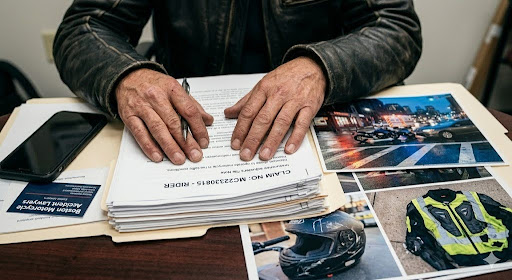
At the scene(if you’re physically able): Photograph the road, the other vehicle, your bike, your gear, skid marks, traffic signals, and signage. Get witness names and numbers before they leave. If there’s a business nearby with exterior cameras, note it immediately—that footage gets overwritten fast.

Your gear is evidence. Don’t wash your jacket or helmet. Don’t let anyone “clean up” your bike before it’s been documented. The condition of your protective equipment tells a story about impact force and point of contact that can directly support your injury claims.

Your recovery is evidence too. Keep a journal—not for dramatic effect, but because pain levels, mobility limitations, missed work, and emotional impact are all components of a bodily injury claim that adjusters will try to minimize if you can’t substantiate them. Your word against their skepticism is a losing position. Your contemporaneous notes against their skepticism is a different conversation entirely.

When you’re ready to consult with boston motorcycle accident lawyers or any experienced motorcycle accident attorney, bring everything. The more complete your evidence file, the harder it is for the adjuster’s narrative to stick.

Two Objections I Hear Every Week

“But I was wearing my gear—doesn’t that prove I was being careful?”

It does matter—but not in the way most people expect. Wearing a helmet and proper gear demonstrates responsible riding. But adjusters are trained to flip that framing: “You were wearing full gear, which suggests you were aware of the risks involved.” I’ve seen that exact logic in file notes. It’s maddening, but it’s real.

The point isn’t that gear hurts your claim—it doesn’t. The point is that no single fact protects you from a determined comparative fault argument. The whole picture has to be documented and presented coherently.

“The other driver admitted fault at the scene.”

That admission matters, but it doesn’t close the case. Adjusters are not bound by what their insured said at the roadside. They will conduct their own investigation, and if they can find any basis to shift a percentage of fault onto you, they will use it to reduce what they owe. Roadside admissions are a starting point, not a finish line.

Before You Sign Anything: Your Real Next Steps

Here’s the short version—no qualifications, no hedging:

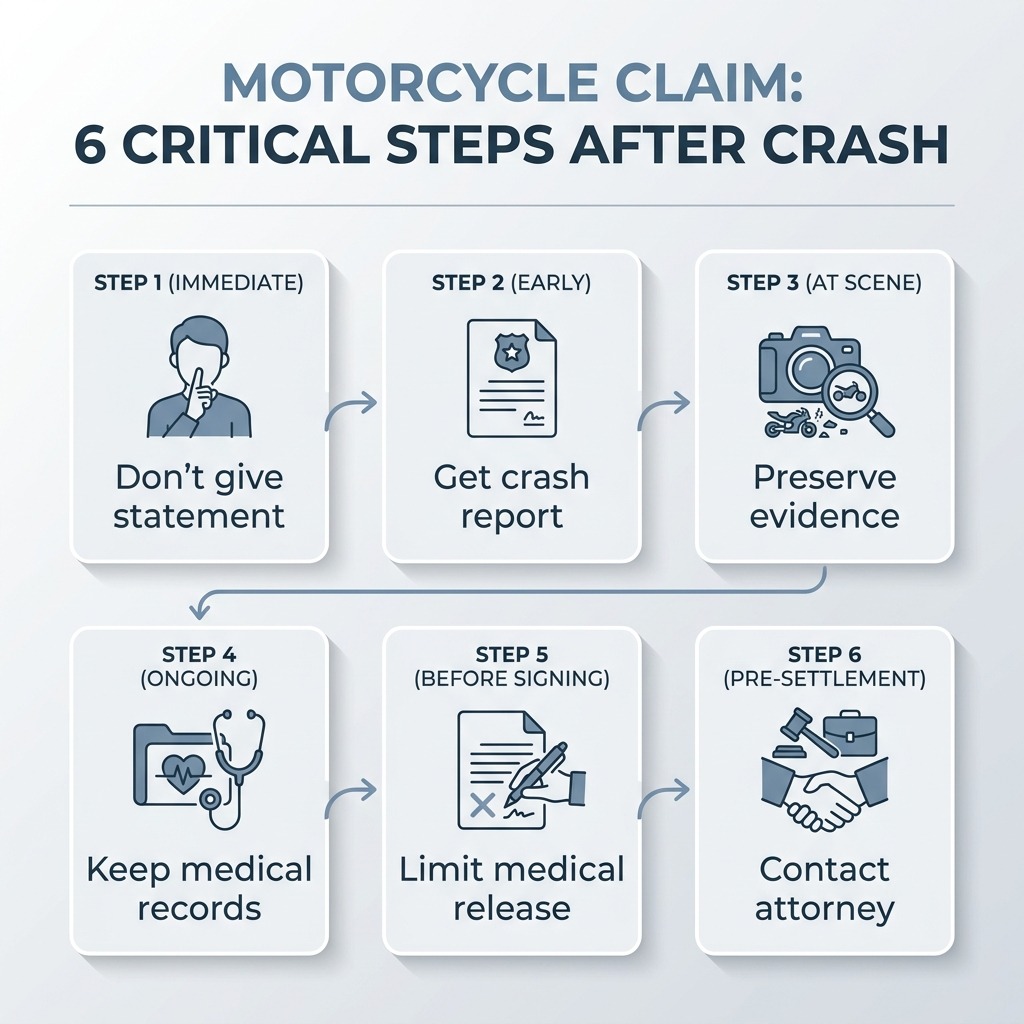
  1. Don’t give a recorded statement to the other driver’s insurer.
  2. Request the crash report yourself and read it before you discuss the facts with anyone.
  3. Preserve all physical evidence—gear, photos, witness contacts, anything from the scene.
  4. Keep a consistent medical record and document how your injuries affect your daily life.
  5. Don’t sign a blanket medical authorization that hands over your full health history.
  6. Talk to a motorcycle accident attorney before any settlement offer is on the table.

The claim process isn’t designed to be fair to you automatically. But it isn’t designed to be impossible either—not if you know what’s happening and move before the narrative hardens.

You felt the bias in that first phone call for a reason. Trust that instinct, document everything, and don’t let anyone turn your choice to ride into a reason to pay you less than you’re owed.

From Distress to Redress: The Role of Elite Legal Minds in Navigating Recovery Paths

Navigating legal challenges can seem daunting, yet finding expert guidance should be straightforward. At Cohen & Marzban, home to the best personal injury lawyer in Los Angeles, located at 714 W Olympic Blvd STE 631, we provide accessible and dependable legal consultations. Navigating Los Angeles to reach our office is straightforward, no matter your starting point:

❗ From Hollywood Bowl:

  • Start by heading south on Highland Ave towards Odin St.
  • Continue onto Cahuenga Blvd W.
  • Merge onto US-101 S.
  • Take exit 2B for Olympic Blvd toward 9th St.
  • Continue on W Olympic Blvd. Our office, Suite 631, will be on your right.

❗❗ From The Natural History Museum of Los Angeles County:

  • Begin on Exposition Blvd heading west.
  • Turn right onto S Figueroa St.
  • Turn left onto W Olympic Blvd.
  • Our office is located on the right side of the street.

❗❗❗ From The Grove:

  • Start heading south on The Grove Dr.
  • Turn Right onto 3rd St.
  • Turn Right onto Fairfax Ave.
  • Turn right onto Olympic Blvd.
  • Continue on W Olympic Blvd. Our office, Suite 631, will be on your right.

Why Cohen & Marzban is Your Trusted Legal Partner:

At Cohen & Marzban, we are dedicated to providing top-tier legal services with a focus on compassion and understanding. Don’t navigate your legal challenges alone. We invite you to visit Cohen & Marzban for expert legal guidance and support. Contact us or visit our office for a personalized consultation and let us help you find clarity and resolution.

Driving Directions: From The Natural History Museum of Los Angeles County to Cohen & Marzban – https://maps.app.goo.gl/q2S5VjyL7wp8gK388

How a Personal Injury Lawyer in New City Can Help You After an Accident

When life throws you a curveball, the right legal support can make all the difference. At Fellows Hymowitz & Rice, we are committed to fighting for your rights and helping you navigate the complexities of personal injury claims with care and dedication. Our office is conveniently located at 888 Grand Concourse, Suite 1-O, Bronx, NY 10451, and we ve made it easy to get to us from key locations around the Bronx and beyond. Here s how you can reach us:

📍 From the Bronx Zoo

If you re coming from the iconic Bronx Zoo, head south on Southern Blvd toward E 183rd St.

  • Turn right onto E 183rd St and continue for about 0.5 miles.
  • Turn left onto Grand Concourse, and you ll find us about 0.3 miles ahead on your left.
  • Our office is conveniently located in a welcoming building, just after the intersection with E 174th St.

📍 From Yankee Stadium

Whether you’re coming from catching a game or a tour, we re just a short distance away!

  • Head south on River Ave toward E 161st St.
  • Turn right onto E 161st St, then turn left onto Grand Concourse.
  • Continue for about 0.5 miles, and you’ll find Fellows Hymowitz & Rice on your right at the corner of Grand Concourse and E 174th St.

📍 From the Bronx River Parkway

Taking the Bronx River Parkway? We re easy to find!

  • Take the Grand Concourse exit and continue heading north.
  • Drive for about 1.5 miles, and our office will be on your right, just past E 174th St.
  • You ll see our sign at 888 Grand Concourse, welcoming you to a team ready to assist with your personal injury case.

📍 From New York Presbyterian Hospital (Bronx Campus)

If you re in need of expert legal advice after a medical issue or injury, we re just minutes away.

  • Head north on Grand Concourse, passing E 169th St.
  • After about 0.6 miles, Fellows Hymowitz & Rice will be on your right, just past the intersection with E 174th St.

Why Choose Fellows Hymowitz & Rice as Your Personal Injury Lawyer in New City?

At Fellows Hymowitz & Rice, we don t just offer legal services we offer a partnership to guide you through life s toughest challenges. Our experienced Personal Injury Lawyer New City is committed to helping you secure justice and the compensation you deserve. Whether you’re dealing with a car accident, a slip-and-fall injury, or any other form of personal injury, we re here for you.

Don t wait your path to recovery starts here!

CID of Area – https://www.google.com/maps?cid=6399709930159109313

The Hidden Dangers of Everyday Products: Product Liability Cases

Product liability cases are crucial in holding manufacturers accountable for the safety of their products. From household appliances to children’s toys, everyday products can pose hidden dangers that result in serious injuries. In this article, we explore the prevalence of product liability cases and the significant role of experienced attorneys, including Westchester spine injury lawyer and “broken bone injury lawyer” services, in advocating for victims of product-related injuries. Continue reading…

Understanding Liability in Multi-Vehicle Accidents

Multi-vehicle accidents can bring about chaos and devastation, involving numerous vehicles and often resulting in severe injuries or fatalities. In such instances, understanding liability is paramount for all parties involved, from victims seeking compensation to insurance companies assessing claims. In this article, we explore the intricacies of liability in multi-vehicle accidents and the importance of seeking legal counsel from specialized attorneys, such as those offering services as Westchester truck accident lawyer. Continue reading…

The Anatomy of a Broken Bone Lawsuit: Key Considerations for Plaintiffs

Suffering a broken bone due to someone else’s negligence can be a physically and emotionally painful experience. In such cases, understanding the process of a broken bone lawsuit becomes crucial for plaintiffs seeking justice and compensation. This article delves into the key considerations individuals should keep in mind when navigating the legal journey after sustaining a broken bone injury and highlights the importance of seeking guidance from a skilled Westchester broken bone lawyer. Continue reading…

Uncovering Hidden Dangers: Product Liability Cases That Changed the Game

Product liability cases have played a pivotal role in shaping consumer safety regulations and holding companies accountable for their products. From defective toys to faulty electronics, these cases shed light on hidden dangers that could cause severe injuries or even fatalities. In this article, we delve into the historical significance of product liability cases, common types of product-related injuries, and the essential role of experienced attorneys, including Westchester burn injury lawyer. Continue reading…

Legal Recourse for Construction Injuries: Understanding Workers’ Rights and Employer Responsibilities

When accidents occur on construction sites, it’s essential for workers to understand their legal rights and options for seeking compensation. In this article, we’ll delve into the legal landscape surrounding construction injuries, exploring workers’ rights, employer responsibilities, and the pivotal role of Westchester County construction injury attorney in advocating for injured workers. Continue reading…

Wrongful Death in Car Accidents: Seeking Justice for Victims and Families

The sudden loss of a loved one in a car accident is a devastating experience that can leave families grappling with grief, emotional trauma, and financial hardships. When a car accident results in wrongful death due to the negligence or misconduct of another party, seeking justice becomes paramount for the victims’ families. We’ll explore the legal recourse available to families affected by wrongful death in car accidents and the crucial role of Westchester County wrongful death attorneys in pursuing justice.

Understanding Wrongful Death in Car Accidents

Wrongful death in car accidents occurs when a person dies as a result of another party’s negligent or reckless actions behind the wheel. Common causes of fatal car accidents include distracted driving, speeding, drunk driving, reckless behavior, and vehicle defects. These tragic incidents not only result in the loss of life but also inflict immense pain and suffering on the victims’ families, who may struggle to cope with the emotional and financial repercussions of their loss.

  • Causes of Fatal Car Accidents: Distracted driving, speeding, drunk driving, reckless behavior, and vehicle defects are among the leading causes of fatal car accidents.
  • Legal Definition of Wrongful Death: Wrongful death is defined as a death caused by the negligent or intentional actions of another party, giving rise to a civil claim for damages.
  • Impact on Families: Wrongful death in car accidents leaves families devastated, facing emotional trauma, financial burdens, and the challenge of rebuilding their lives in the aftermath of loss.

Legal Recourse for Victims and Families

Families affected by wrongful death in car accidents have legal recourse to seek compensation and accountability for their loss. Wrongful death claims allow families to pursue damages for various losses, including medical expenses, funeral costs, lost income, loss of companionship, and pain and suffering. However, navigating the legal process and proving liability in wrongful death cases can be complex and challenging, requiring the expertise of experienced wrongful death attorneys and accident attorney Westchester NY. Continue reading…

Fractured Futures: The Financial Impact of Bone Fractures and Legal Remedies

A bone fracture can have far-reaching consequences, impacting not only one’s physical health but also their financial well-being. In this article, we delve into the significant financial implications of bone fractures and explore the legal remedies available to individuals seeking compensation for their injuries. From understanding the costs associated with bone fractures to the role of Westchester bone fracture lawyer in pursuing legal recourse, let’s uncover the complexities of fractured futures. Continue reading…

Single-Vehicle Accidents: Exploring Causes and Liability in Solo Car Crashes

Single-vehicle accidents, although less common than multi-vehicle collisions, can still have serious consequences for drivers and passengers. Understanding the causes and liability in solo car crashes is essential for those involved in such accidents. In this article, we’ll delve into the factors contributing to single-vehicle accidents, the potential liability of drivers, and the role of Westchester car accident lawyer in navigating legal proceedings and securing compensation for those affected. Continue reading…

Children and Burn Injuries: Safety Tips for Parents and Caregivers

As a parent or caregiver, ensuring the safety and well-being of children is a top priority. Unfortunately, burn injuries are all too common among children and can have serious and long-lasting consequences. In this article, we’ll explore essential safety tips to help parents and caregivers prevent burn injuries and protect their children from harm, while also emphasizing the importance of seeking legal guidance from a qualified Westchester County NY burn injury lawyer Continue reading…