I remember the exact moment I understood what I’d been doing for years on the defense side.
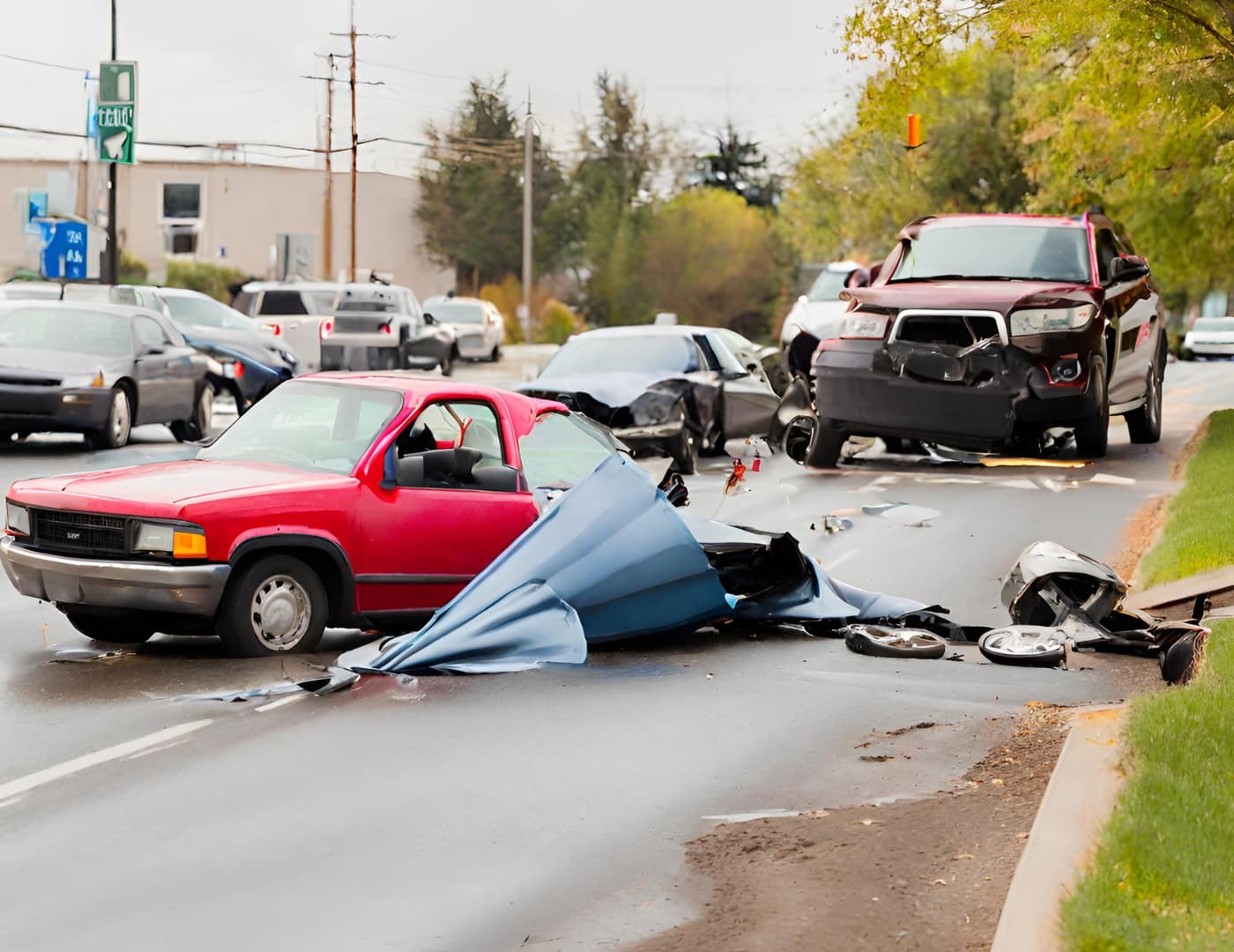
A rider came in—mid-40s, commuter, T-boned at a feeder road intersection near Beltway 8. Clear liability. The other driver ran a red light. But when I pulled the adjuster notes from the file I was reviewing, the first three entries weren’t about the at-fault driver. They were about the motorcyclist. His lane position. Whether he was wearing a high-visibility jacket. A note that read, “claimant chose to operate motorcycle in heavy traffic conditions.”
That last line wasn’t a fact. It was a frame. And I’d been building those frames for years without fully registering what they were doing to real people.
That’s why I’m writing this now. Because I see Houston riders every week who felt something was wrong in their claim—felt the skepticism through the phone, felt the questions tilting toward them—but didn’t have the language to name it or the steps to push back before the process hardened against them.
How the Adjuster Frame Gets Built Before You Finish Your Sentence
The insurance adjuster who calls you after a crash is not your advocate. That’s not cynicism—it’s the job description.
Their role is to evaluate liability and control claim costs for their employer. What I want you to understand is that the framing of your claim often begins in that first conversation, sometimes before you’ve even described the crash. Here’s what that looks like in practice.
The adjuster sounds empathetic. They ask how you’re doing. Then the questions start shifting:
- “Were you wearing a helmet?”
- “What speed were you traveling?”
- “Were you in the lane or splitting?”
- “Is that road familiar to you?”
Each question, individually, sounds reasonable. Together, they’re building a file note that says: this rider made choices that contributed to this outcome. That’s the foundation of a comparative fault argument, and it’s being laid while you’re still in a hospital gown.
Texas follows a modified comparative fault rule—meaning if you’re found more than 50% responsible for your own injuries, you recover nothing. Below that threshold, your recovery gets reduced by your percentage of fault. So when an adjuster asks about your speed or lane position, they’re not making small talk. They’re prospecting for percentages.
The bias isn’t usually a slur. It’s procedural. It shows up in which questions get asked first, whose account gets documented in detail, and what gets flagged as a “contributing factor.” Federal crash data shows 6,335 motorcyclists were killed in U.S. traffic crashes in 2023—these are high-stakes claims involving serious bodily injury, and insurers know that.
The Negligence Timeline You’re Actually Living Through
Most riders think the crash is the event. In a claim, the crash is just the starting point.
What happens in the weeks after is where negligence gets defined and liability gets contested. Negligence, in plain terms, means someone failed to act with reasonable care and that failure caused your injuries. In a motorcycle crash, you’re usually arguing that the other driver was negligent—ran a light, failed to yield, merged without checking mirrors. But the other side’s job is to introduce doubt about your own conduct.
Where riders lose ground without knowing it:
| Mistake | Why It Hurts You |
|---|---|
| Giving a recorded statement too early | You haven’t reviewed the crash report yet—your account may contradict evidence that supports you |
| Accepting the adjuster’s scene characterization | Their version becomes the baseline for all future negotiations |
| Not pushing back on soft negligence framing | Phrases like “motorcycles are harder to see” sound neutral but assign partial blame |
| Assuming the police report closes the question | Adjusters conduct independent investigations regardless |
Liability is the legal conclusion that flows from negligence. Establishing it clearly—through police reports, witness statements, traffic camera footage, and physical evidence from the scene—is what prevents the adjuster from successfully muddying the water. A clean liability picture early in the process is worth more than any argument you can make later.
If you’re in the middle of this right now, the most important thing I can tell you is: stop giving information and start gathering it. You are not obligated to provide a recorded statement to the other driver’s insurer. You are not obligated to explain your riding choices. Your job at this stage is documentation, not defense.
What Your Medical Records Are Actually Being Used For
This is the section most riders don’t think about until it’s too late.
When an adjuster requests your medical records—especially when they ask for records going back five or ten years—they are not trying to understand your injuries. They are looking for pre-existing conditions they can use to argue that your current pain, your surgery, your time off work, was already happening before the crash.
Say you had a prior knee surgery five years ago. You crash, and now you have a fractured patella. The adjuster’s argument becomes: “We can’t separate the crash injury from the pre-existing condition.” In Texas, that argument has limits—you’re entitled to compensation for aggravation of a pre-existing condition, not just new injuries—but it takes documentation to prove where the baseline was and how the crash changed it.
This is why your medical treatment after the crash needs to be consistent, documented, and connected. Every gap in treatment becomes an argument that you weren’t really hurt. Every complaint you didn’t mention to your doctor becomes a symptom the adjuster can claim didn’t exist. The NHTSA’s own data on helmet effectiveness shows that protective gear reduces fatal injury risk by 37%—but even riders who did everything right still end up with serious injuries, and those injuries need a clear medical paper trail from day one.
Don’t sign a blanket medical authorization. Work with your attorney to provide records that are relevant to the crash injuries, not your entire health history handed over for the adjuster to mine.
Building Evidence Before the Adjuster Builds Their Narrative
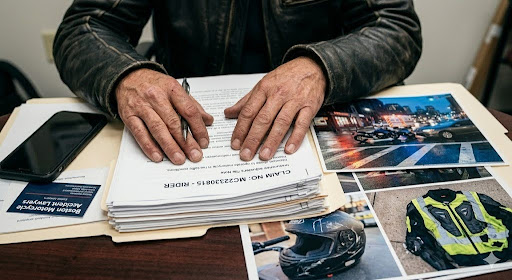
Evidence in a motorcycle injury claim isn’t just the police report. It’s everything that tells the true story of what happened and what it cost you.
At the scene(if you’re physically able): Photograph the road, the other vehicle, your bike, your gear, skid marks, traffic signals, and signage. Get witness names and numbers before they leave. If there’s a business nearby with exterior cameras, note it immediately—that footage gets overwritten fast.
Your gear is evidence. Don’t wash your jacket or helmet. Don’t let anyone “clean up” your bike before it’s been documented. The condition of your protective equipment tells a story about impact force and point of contact that can directly support your injury claims.
Your recovery is evidence too. Keep a journal—not for dramatic effect, but because pain levels, mobility limitations, missed work, and emotional impact are all components of a bodily injury claim that adjusters will try to minimize if you can’t substantiate them. Your word against their skepticism is a losing position. Your contemporaneous notes against their skepticism is a different conversation entirely.
When you’re ready to consult with boston motorcycle accident lawyers or any experienced motorcycle accident attorney, bring everything. The more complete your evidence file, the harder it is for the adjuster’s narrative to stick.
Two Objections I Hear Every Week
“But I was wearing my gear—doesn’t that prove I was being careful?”
It does matter—but not in the way most people expect. Wearing a helmet and proper gear demonstrates responsible riding. But adjusters are trained to flip that framing: “You were wearing full gear, which suggests you were aware of the risks involved.” I’ve seen that exact logic in file notes. It’s maddening, but it’s real.
The point isn’t that gear hurts your claim—it doesn’t. The point is that no single fact protects you from a determined comparative fault argument. The whole picture has to be documented and presented coherently.
“The other driver admitted fault at the scene.”
That admission matters, but it doesn’t close the case. Adjusters are not bound by what their insured said at the roadside. They will conduct their own investigation, and if they can find any basis to shift a percentage of fault onto you, they will use it to reduce what they owe. Roadside admissions are a starting point, not a finish line.
Before You Sign Anything: Your Real Next Steps
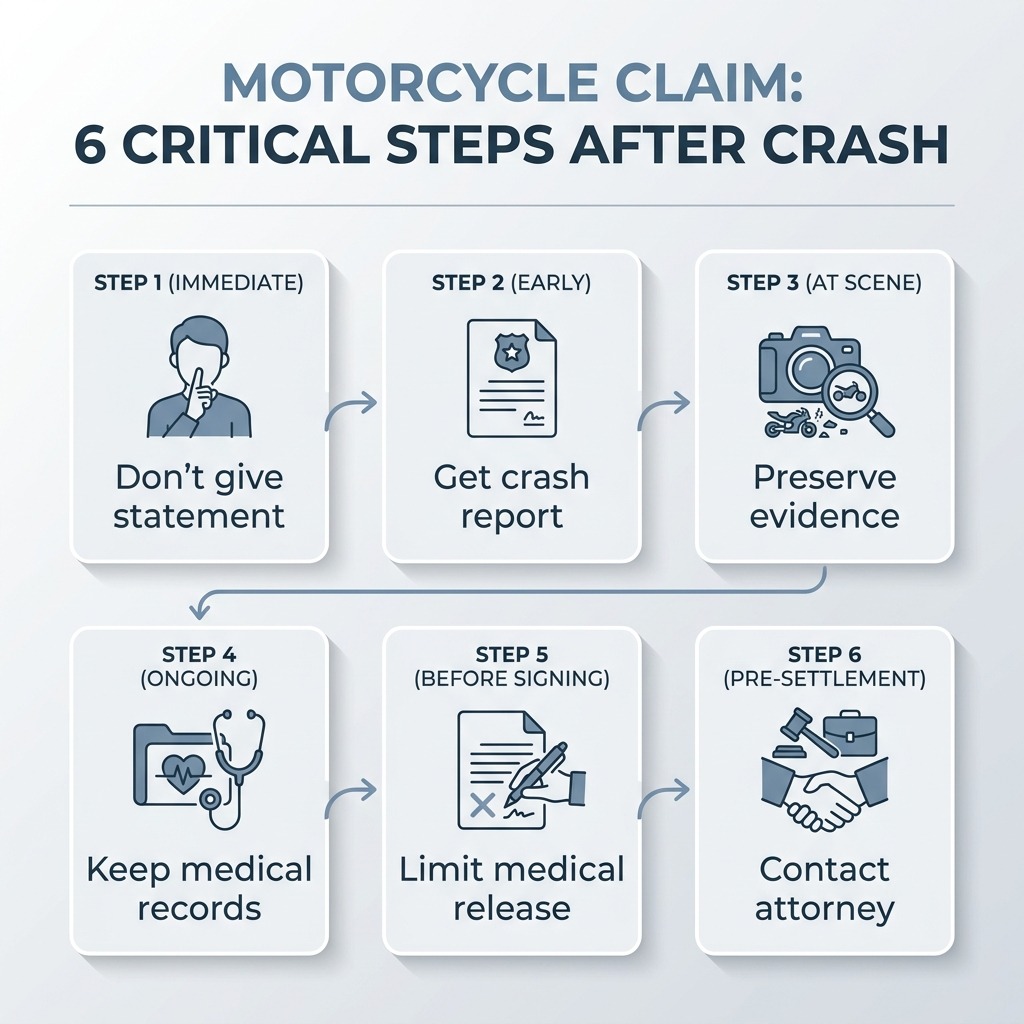
Here’s the short version—no qualifications, no hedging:
- Don’t give a recorded statement to the other driver’s insurer.
- Request the crash report yourself and read it before you discuss the facts with anyone.
- Preserve all physical evidence—gear, photos, witness contacts, anything from the scene.
- Keep a consistent medical record and document how your injuries affect your daily life.
- Don’t sign a blanket medical authorization that hands over your full health history.
- Talk to a motorcycle accident attorney before any settlement offer is on the table.
The claim process isn’t designed to be fair to you automatically. But it isn’t designed to be impossible either—not if you know what’s happening and move before the narrative hardens.
You felt the bias in that first phone call for a reason. Trust that instinct, document everything, and don’t let anyone turn your choice to ride into a reason to pay you less than you’re owed.